NEW US WAREHOUSES Alongside our France-based shipping , we now ship from California & Washington DC — faster, cheaper US delivery. DISCOVER

Delamain Cognac

Delamain Cognac

Founded in 1824 and still guided by the ninth generation of the Delamain family, Delamain embodies a vision of cognac rooted in observation, patience and respect for nature. Specializing exclusively in Grande Champagne, Cognac’s first and finest cru, Delamain crafts only rare eaux-de-vie, guided by ancestral savoir-faire and a non-interventionist approach.

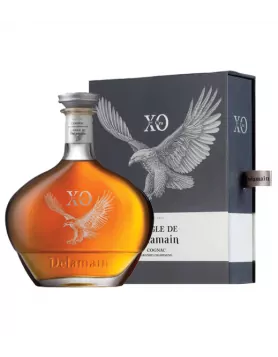
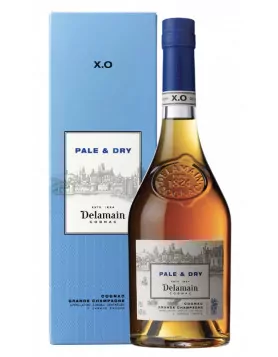
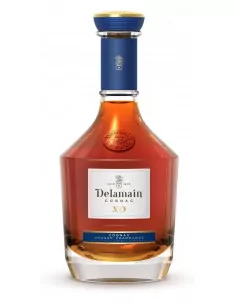
The style shines in Pale & Dry XO (42 %), a modern classic defined by floral finesse, dried apricot notes and perfect balance. Delamain XXO moves into deeper, gourmand territory, with notes of ripe fruit and spices, matured in the House’s oldest cellars.

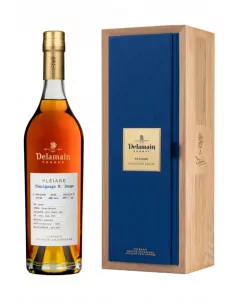
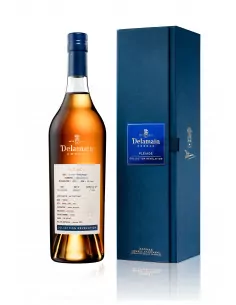
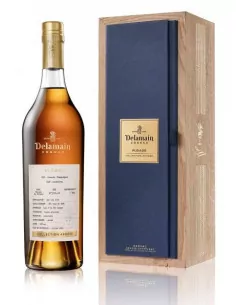
The Pléiade trilogy showcases rare single-vineyard, single-vintage and single-cask marvels—bottled unblended, unfiltered and uncompromisingly pure. At the summit sits L’Oiseau Rare, a blend of the cellar’s most elusive casks, offering near-endless length. From vine to glass, Delamain’s meticulous, nature-led philosophy yields Cognacs of unmatched purity, finesse and timeless elegance

Visit Delamain: 7, rue Jacques et Robert Delamain ,16200 Jarnac ,+33 (0)545810824

Products

Active filters

Showing 1-12 of 12 item(s)
Showing 1-32 of 32 item(s)

Uncompromising Pursuit of Purity

Delamain Deep Dive

There are houses in Cognac that evoke centuries of artisanal craftsmanship, but few stand as singularly committed to purity and finesse as Delamain. Situated in Jarnac, Delamain has cultivated a reputation for producing Cognacs that are both ethereal and unfailingly pure, defined by their meticulous processes and close alliance with nature. Visiting Delamain is less like stepping into a Cognac house and more like entering a living tradition—where each generation leaves a signature, yet the unbroken pursuit of excellence remains constant.

As one walks through the chai or sits and tastes surrounded by the emblematic Delamain blue—borrowed from a centuries-old china set used for special weddings—one senses the quiet intensity that drives the house. Here, Cognac is indeed a spirit and also a philosophy, with time and terroir considered sacred partners in creation.

In this deep-dive article, we trace the house’s evolution, their intimate alliance with nature, and the intricate methods that define Delamain as a touchstone for connoisseurs - and for all of us at Cognac Expert. We kicked off our visit in the house garden with Eric Le Bouar and Rebecca Montgomery, who graciously showed us around and told us the complete Delamain story.

People & History

The story of Delamain begins in 1752, when James Delamain first arrived in France, marking the start of a remarkable journey. Through the centuries, each generation of the family has brought a new dimension to the house—often shaped by their keen curiosity about the natural world. The Delamains have always been more than merchants or producers; they are thinkers, naturalists, and keen observers of nature. As such, any visit to Delamain begins in the house garden.

Jacques Delamain, for example, was an acclaimed ornithologist, while Jean Delamain’s botanical expertise led to the discovery of a unique local orchid. Robert Delamain, deeply familiar with the land, played a pivotal role in charting the Cognac crus and authored the seminal “L'Histoire du Cognac.” Maurice Delamain, meanwhile, helped to found Éditions Stock, linking the family’s legacy to literature and culture. This complex mosaic of passions and talents imbued Delamain with a spirit of intellectual rigor and wonder, which echoes through the house’s methods and philosophy to this day.

The current cellar master, Charles Braastad, represents the ninth generation at the helm. His stewardship continues the Delamain tradition of blending empirical knowledge with astute intuition—a legacy built on close observation, respect for the land, and an unwavering commitment to quality.

Taylor talking to Rebecca

Eric in one of Delamain's cellars

A Close Alliance with Nature

Perhaps more than any other Cognac house, Delamain’s ethos is shaped by a profound relationship with nature. The Delamain family has long believed that careful study of the environment is essential—not just for great Cognac, but for an enduring way of life. This deep connection has inspired a scientific approach to production, but one always rooted in genuine love and respect for the natural world.

Every fundamental decision at Delamain, from vineyard management to aging practices, traces back to this alliance. The result is a production style defined by patience, precision, and purity. The family’s intimate understanding of the rhythms of the region means that nature is not merely a backdrop but an active partner, guiding choices on everything from grape selection to blending.

This philosophy is not just some abstract ideal. It is lived out daily in the vineyards, in the selection of only the finest Grande Champagne eaux-de-vie, and in the refusal to add anything superfluous to their Cognac. At Delamain, transparency and honesty are articles of faith.

La Rambaudie

The heart of Delamain’s vineyard holdings beats at La Rambaudie, a prized 20-hectare estate planted in the premier cru of Grande Champagne. This plot, with its deep chalky soils and optimal exposure, offers the house access to some of the most coveted grapes in the region. 

Each vine at La Rambaudie is tended with care, not unlike how they treat the plants and flowers in their garden, embodying the same patience that defines Delamain’s approach to aging and blending. The family’s close relationship with the land is a vibrant force shaping the Delamain Cognacs of today and tomorrow. The house also sources spirit directly from close partners exclusively in the Grande Champagne cru. Without a doubt, these grower partners approach the vineyard, wine production, and distillation no differently than Delamain themselves at their home domaine at La Rambaudie.

Distillation, Aging & Blending

Delamain’s production process is remarkable in its restraint and its attention to detail. The house works closely with a dedicated distillation partner, a relationship that has matured over decades. This collaboration ensures that the spirit delivered to Delamain is a perfect canvas for their artistry. In fact, we tasted some very fresh eau-de-vie from barrel and can confirm that its florality, crystalline presence of fruit, and purity are indeed above the norm.

Once the eaux-de-vie arrive, the real magic begins. Aging takes place across two main locations—Jarnac and Vinade—spanning a network of large and small chais, each with distinct humidity profiles. Higher levels tend to be dry, encouraging a slow and elegant evolution of flavor, while the lower, more humid cellars foster deeper integration and softness.

A key to Delamain’s approach is the exclusive use of old barrels. Remarkably, new oak is never employed, allowing the spirit’s purity to shine and preventing overwhelming wood notes. The blending process is led by the cellar master and two expert chai managers, who also identify and set aside certain casks for vintage or single cask bottlings. This careful curation ensures that every bottle bearing the Delamain name embodies the house’s signature finesse.

A Special Note About The Delamain Reduction

Perhaps nowhere is Delamain’s pursuit of purity more evident than in their unique reduction process—a practice that stands apart from many other Cognac houses. Instead of reducing the alcohol content with water, Delamain employs a method that relies on time and a perpetual blend they call their “faibles.”

Take their celebrated Pale & Dry expression as an example. After distillation, the young eau-de-vie spends close to two decades aging in old oak barrels on the drier upper levels of the chai. The Faibles are starting to be added when the blend occurs once the different eau-de-vie have matures sufficiently. Then then the blend is transfered to the humid lower level. A remarkable, solera-style blend that has been in continuous use for around a century. This faibles, with an alcohol content of just 15%, is topped up annually and serves as the agent for reduction. Think of this as a perpetually blended Cognac that first was established 100 years ago but whose alcohol content is 15% - and whose aromatic intensity is exceedingly high.

The Cognac, now infused with the complexity of the faibles, is then placed into smaller old barrels and left to continue its gentle journey toward bottling strength - all in the humid lower level. Through this patient, waterless process, the Cognac naturally descends to 42% ABV, all while gaining texture, softness, and depth. The result is a spirit that is refined, floral, and delicately dry, with every nuance preserved - no wrinkles. And again, no new oak was touched in the process. This fact is perfectly in step with their quest for purity and elegance.

The Range

Delamain’s collection is a celebration of nuance, terroir, and the artistry of aging. Each expression offers a different facet of their house style, united by an overarching commitment to elegance and purity. Pale & Dry XO serves as a modern classic, now bottled at 42%. It is notable for its floral, pretty aromatics and an elegant, dry finish—a Cognac that is at once refined and accessible. A classic but resolutely modern XO.

Delamain XXO is a more opulent and comforting expression, presented in a handsome decanter. It offers a gourmand character, with a reassuring depth and a generosity that invites leisurely contemplation. A satisfying and reassuring Cognac.

The Pléiade Collection stands as a trilogy of singularities: one bottling from a single vineyard (La Rambaudie), one from a single vintage (such as the 1995), and one from a single cask (like the "Rare Ancestral 25.1 and 25.2" casks). The single vinyeard La Rambaudie is the gateway, fresh and expressive, while the Vintage 1995 showcases the intensity and character Delamain is capable of. The single cask edition, such as the Rare cask Ancestral, display the mature side of Grande Champagne—candied fruit, spice, quince paste, and honey, all delivered with impeccable finesse and the hallmark absence of overt oak. Length can be counted in minutes, not seconds.

At the summit sits L’Oiseau Rare, a blend composed of the rarest discoveries from the cellar. The previous acting cellar master called these gems “rare birds” when he found them and set them aside and blended them from the outset in a large old foudre (oak tank). The result is an almost mythic Cognac, complete in its balance, harmony, and near-endless finish. If a perfect Cognac exists, this could indeed be it.

Delamain Highlights

To Close

To truly appreciate Delamain is to understand the power of restraint, the virtue of patience, and the magic that results when nature is treated not as a resource, but as an equal partner. Every bottle demonstrates the Delamain family’s unwavering quest for purity, a philosophy that refuses shortcuts and embraces the slow, mysterious work of time.

In a world where Cognac is often measured by luxury and showmanship, Delamain remains devoted to something quieter but infinitely more precious: the transmission of wisdom from generation to generation, and the respectful unveiling of Grande Champagne’s soul, one drop at a time. For the true enthusiast, a glass of Delamain should be on everyone's list, from the Pale & Dry all the way to the highest heights. There is a Delamain Cognac for everyone, and we could not be happier to share the House’s story and its Cognacs with you.

History of Delamain

1625 was the year that Nicolas Delamain escaped France's Protestant reign to England, where he would soon be knighted by Charles I to receive the coat of arms, which until this day adorns the trademark of the Delamain company, 3 bloody crosses.

Nicholas was appointed to Ireland and for generations to follow, the Delamain lineage was continued: by Nicholas himself, Henry I, Henry II and Henry III.

This is where things get a little complicated, but the last Henry brother, William, had a son called James. It was he who would return to France in 1759 at the age of 21. He traveled to Jarnac in Charente, where he joined the cognac trader Issac Ranson, whose trade can be traced back to the very early beginnings of cognac production.

James was responsible to see to the Irish market via his family network and when he finally married Ranson's daughter Marie in 1762 he became a partner in the company, which was then named Ranson & Delamain. 

Throughout the 18th century, Ranson & Delamain became one of the leading cognac houses, starting to strongly force export trade towards the end of the century - this was before the French Revolution hit the Cognac industry. Adding to this difficult economic time, brought about by the Napoleonic Wars and the Continental trade blockage, James also had a very difficult relationship with his son Jacques.

When James dies in 1800, the French inheritance law resulted in a complete division of the company into seven parts, because he had seven children.

It took 20 years and many failed attempts to reassemble the Cognac house. James's grandson Anne-Philippe Delamain brought the company back together with two of his cousins from the Roullet family. Hence, the name of the cognac house changed again, this time to Roullet & Delamain.

Again, the business was handed down through generations until in 1920 Jacques and Robert Delamain, the then owners of the cognac house bought out Roullet's shares and the firm finally became Delamain & Co.

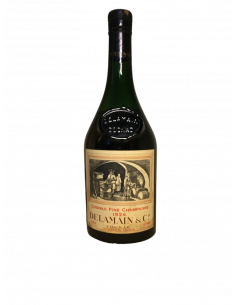
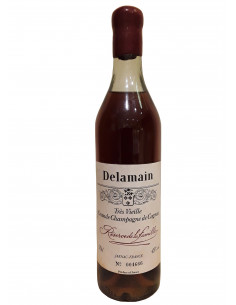
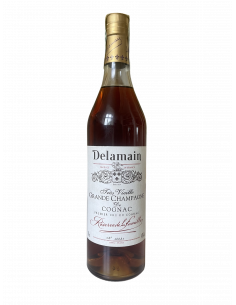
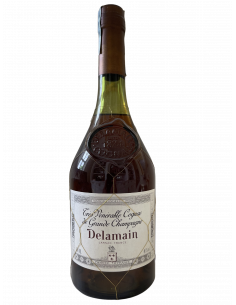
In that same year they baptized their Cognac classics "Pale & Dry" and "Tres Belle Grande Champagne". In 1953, the following Delamain Cognac was introduced by Jacques's son Jean, namely "Grande Champagne Vesper".And in 1976, continuing the complex family network, Jean's niece's husband Noel Sauzey came up with the next Cognac "Tres Venerable Grande Champagne".

After this short intersection of a different family name (!) the company direction was taken over by Alain Braastad-Delamain, the grandson of Robert, and is the managing director of the house until this day. 


Delamain Today

Today, Delamain is one of the last family-run Cognac houses that exist, especially one with such an old tradition. Formerly run by Delamain descendants and cousins Charles Braastad and Patrick Peyrelongue, they are now part of the Bollinger wine group (SJB) with Braastad as Manager Director. They surveil production under the strictest regulations in order to create the most exquisite product.

The selectivity when it comes to the growers and distillers that Delamain frequents to produce their cognac is extreme. Every purchase gets tested by several people, including of course the cellarmaster Dominique Touteau. Of around 400 samples received each year from various producers in the Charente, one 10% get selected.

Delamain is perhaps the most traditional cognac house around these days, counting solely on exclusivity and a certain aristocratic savoir-vivre.


News, Products, Anecdotes and Labels

Detail lies at the heart of Delamain Cognac. Believe it or not, but before being boxed, every bottle is actually rinsed with cognac, then hand-fitted with labels, wax seals of the finest quality, and inspected for its clarity and color.

Robert Delamain, also a distinguished archaeologist and author, wrote the still definitive work on Cognac "Histoire du Cognac" published in 1935.


Visit Delamain

Delamain offers visits to the estate and the cellars, but only upon appointment. Please contact the cognac house to arrange your visit.

See some blog posts related to Delamain Cognac

Delamain Cognac: A Journey Through Time and Tradition
Aug 02, 2017

All Articles

Delamain Cognac: A Journey Through Time and Tradition
If you’ve not yet familiar with Delamain Cognac, then we have to say, you’re in for a treat.  With a history that can be traced back to the 1600s, Delamain could, quite legitimately, be considered...
La Part des Anges 2018: Cognac charity auction
Jun 22, 2018

All Articles

La Part des Anges 2018: Cognac charity auction
Since its inception 11 years ago, the specialty Cognac auction known as La Part des Anges (The Angel’s Share) has gone from strength to strength. With all proceeds going to charity, this is an...
6 Best Cognac Tasting Sets
Jun 28, 2017

All Articles

6 Best Cognac Tasting Sets
Once you discover the joy that is Cognac, it’s natural to want to learn more about the tasting process. And one of the best products to purchase if you want to do this is a Cognac tasting set. You...
Visit to Vinexpo 2015
Aug 10, 2015

All Articles

Visit to Vinexpo 2015
Vinexpo is usually covered by Max and Sophie, but unfortunately they couldn’t be there this year, so it was an honor to be able to visit on their behalf. I had heard how big Vinexpo was, but until...
Product added to wishlist
Product added to compare.
You have successfully followed this brand
group_work Cookie consent